:max_bytes(150000):strip_icc():format(webp)/GettyImages-539727442-f21245e266294e18bc7f09da86140490.jpg)
As we read more into William Shakespeare’s The Tragedy of Othello, the Moor of Venice, we often find ourselves asking the questions, “Why does Othello not investigate Iago’s accusations, why is he choosing to believe Iago over his true love, Desdemona?” The play of Othello is a tragedy that involves many characters, the main protagonist Othello and his wife Desdemona, the antagonist Iago and his wife Emilia, and the poor character who is caught in the cross-fire Cassio. Overcome with jealousy and the self-doubt, Othello falls victim to the conniving Iago, who would take advantage of Othello’s gullibility. This doubt that Othello has of his loyal wife, that we know to be true, is cemented and goes without question from Othello because of many reasons.
The camaraderie of the military
The first reason that we can see, from picking up the clues from the play, is of his absolute trust of his military comrade, Iago. Iago and Othello serves in the Venetian army, where Othello is the general and Iago is his underling. We find out from the play very early on that Iago has a deep hatred for Othello. Othello, of course, does not know of this and believes that Iago is a close friend. Where does this hatred originate?
“Were I the Moor I would not be Iago. In following him, I follow but myself. Heaven is my judge, not I for love and duty, but seeming so for my peculiar end. For when my outward action doth demonstrate The native act and figure of my heart In complement extern, ’tis not long after but I will wear my heart upon my sleeve For daws to peck at. I am not what I am.” – Act 1 Scene 1, lines 63-71.
In the military, all you have is each other. The individual to your left and right. They are your brothers and sisters, they are more than family. In Iago and Othello’s case, this is how Othello feels with Iago. The camaraderie that one feels when they are serving is so powerful in shaping someone that if someone were to tell them otherwise, it would shatter their world. In Othello’s case, he believed him completely when Iago tells him that Desdemona has been laying with Cassio. In the play, it is fact that Othello considers Iago a close friend,
” And for I know thou ’rt full of love and honesty And weigh’st thy words before thou giv’st them breath.” – Act 3 Scene 3, lines 136-138.
His self-conscious and self-esteem
Othello is different from his peers. He is of African descent, with a much larger build than those of Venetian; because of this, he is often considered the “moor.” We learn that Othello is from a royal bloodline, he is a prince, but he has darker skin than that of his peers, this makes him the outcast.
“I fetch my life and being from men of royal siege, and my demerits may speak unbonneted to as proud a fortune as this that I have reached.” – Act 1 Scene 2, lines 24-27.
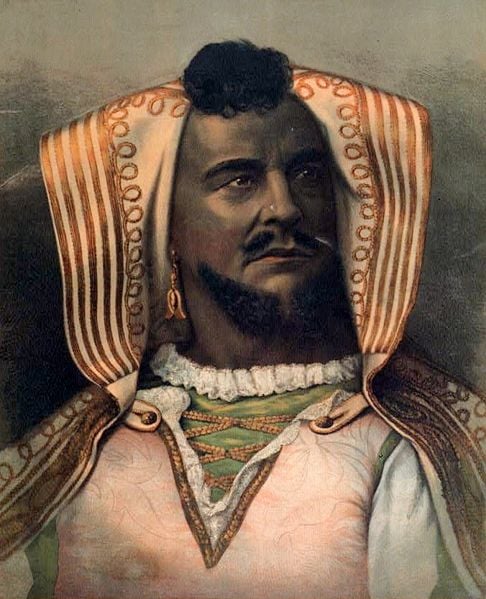
He is led to believe by Iago that his skin color is what causes Desdemona to cheat on him. This is odd because from the start, Othello is very confident in himself. He truly believes that he is in the position and living the lifestyle that he has now because of his merits and self-worth. He would eventually start to have a change of heart when Iago finally convinces him that Desdemona see’s all of Venetian men the same as she see’s Othello. Social belonging is a need that everyone require, and when Othello feels ostracized from everyone and now his lover, he completely changes his character from “gentle giant” to the enraged murderer that we see at the end. According to a study done by Lynn Mulvey, Ph.D in Department of Human Developments, and her colleagues, she claims that social exclusions can cause academic difficulties, decrease in social behaviors, and low-self esteem. This is something that we see in Othello, because of him being a social out cast from the rest, his character changes throughout the play.
Haply, for I am black and have not those soft parts of conversation that chamberers have, or for I am declined Into the vale of years—yet that’s not much— She’s gone, I am abused, and my relief must be to loathe her. – Act 3 Scene 3, lines 304-307.
A true friend
Othello is vulnerable, having no one to call friend after finding out that Desdemona had been secretly cheating on him with Cassio. His mental state is at it’s lowest because of Iago’s lies. Iago, of course, is the only one who has been coaxing these thoughts into Othello’s head, especially with the help of the handkerchief. What is this handkerchief? A sentimental fabric representing his love for Desdemona, woven by a 200 year old sybil woman prophet made from special materials. The handkerchief was passed down from Othello’s mother, who used it to keep his father faithful to her. Othello believes Iago is a honest man, and Othello even has doubts about Iago’s accusations. But over time we see all the red-flags that Iago has been saying come true. This makes Othello believe him without a doubt. Over time, Iago is the only one who seems to be warming up to Othello and confirming his doubts about his wife, Desdemona. With no one to turn to, it’s only obvious that he turns to Iago, who is the only one who seems to be on his side. Throughout the play we see everything that Iago has been telling Othello come true, this adds onto his undying belief of Iago. With the handkerchief being in Cassio’s hands, then with Desdemona always being extra friendly with Cassio, and always talking about him to Othello. These deceits is what cements Iago’s accusations to be true.
Works Cited:
Folger Shakespeare Library. Shakespeare’s Othello from Folger Digital Texts. Ed. Barbara Mowat, Paul Werstine, Michael Poston, and Rebecca Niles. Folger Shakespeare Library, 8 December, 2019. www.folgerdigitaltexts.org
Kay, Carol McGinnis. “Othello’s Need for Mirrors.” Shakespeare Quarterly, vol. 34, no. 3, 1983, pp. 261–270. JSTOR, www.jstor.org/stable/2869886.
Speaks, Schatzie. “Race and Discrimination in ‘Othello’ by William Shakespeare.” Owlcation, Owlcation, 31 July 2019, https://owlcation.com/humanities/Race-in-Shakespeares-Othello.
Stesienko, Andrew (2011) “The Monster in the Moor,” The Oswald Review: An International Journal of Undergraduate Research and Criticism in the Discipline of English: Vol. 13 : Iss. 1 , Article 7.
Lynn Mulvey, Kelly, et al. “Causes and Consequences of Social Exclusion and Peer Rejection Among Children and Adolescents.” Report on Emotional & Behavioral Disorders in Youth, U.S. National Library of Medicine, 2017, https://www.ncbi.nlm.nih.gov/pmc/articles/PMC6085085/.
 It Must Be True!